
Interested in testing your Mandarin language skills? If so, there is one exam you cannot afford to miss. That’s the HSK test, the most popular Chinese proficiency test.
Chinese has become more popular in the past decade. Learning Mandarin offers many benefits, including career opportunities, hobbies, and education in China. You will also gain insight into China’s rich culture, history, and tradition.
You may want to know your current language ability if you are a Chinese learner.
HSK is known to almost everyone who has taken a Chinese course. But what is HSK exactly? Why do you need to take it, and is it worth it?
Let’s learn everything from test centers and fees to dates, test structure, question format, and marking system.
What is HSK?
The acronym HSK stands for Hànyǔ (Chinese), Shuǐpíng (level) Kǎoshì (test). Hence, it refers to the “Chinese Level Test.”
Hanyu Shuiping Kaoshi / 汉语水平考试 is the standard official Chinese test.
HSK measures the language ability of non-native speakers. It is open to foreigners, overseas Chinese, and ethnic minorities within China.
Who conducts the exam?
The Center for Language Education and Cooperation (CLEC) administers the HSK test globally. The Ministry of Education (MOE) of China oversees its operations.
CLEC is a nonprofit educational and cultural organization that promotes Chinese language study and administers standardized tests such as CTCSOL and HSK.
They operate more than 500 Confucius Institutes in more than a dozen countries. It also offers flagship programs such as Chinese Bridge, teacher training, and numerous scholarships.
They promote studying in China and student exchange programs.
Hanban was the last name. However, in July 2020, it changed its name to CLEC amid controversy over its operations.
Recognition of HSK worldwide
HSK was founded in 1984. They conducted the first HSK exam outside of China in 1991.
Over the years, it has become the most prestigious Mandarin language test for non-native Chinese speakers.
The Chinese government institutions officially recognize and award different variants of HSK.
The HSK test is the most popular Chinese language test today. That is why all government bodies, businesses, and public and private educational institutions accept and trust HSK certification.
Should you take the HSK Test?
The HSK offers several benefits. This exam is designed to certify the skills of non-native candidates.
You can use HSK in many ways. This includes, but is not limited to, a relaxed stay in China, jobs requiring Chinese, studying abroad in China, academic pursuits, and confidence-building.
Those who do not speak Chinese as their first language but would like to work or study in China will find it helpful. As an ESL teacher in China, I find it helpful.
You may be unable to impress potential employers with your knowledge of Chinese alone.
In most cases, companies demand documentary evidence before an interview. In that case, HSK credentials could increase your chances of getting shortlisted.
This increases your chances of getting a scholarship, visa, and permanent residency in China.
It also confirms your understanding and motivates you to do better. You become more confident.
Who can take the HSK test?
There are no special requirements or guidelines.
Foreigners who don’t speak Mandarin as a first language can take the HSK test to assess their current ability. It is also open to the Chinese diaspora and ethnic minorities in China.
There is no age restriction. There are no minimum or maximum ages.
The types of HSK examinations
There are 5 main variants of the HSK. The most common is the standard HSK.
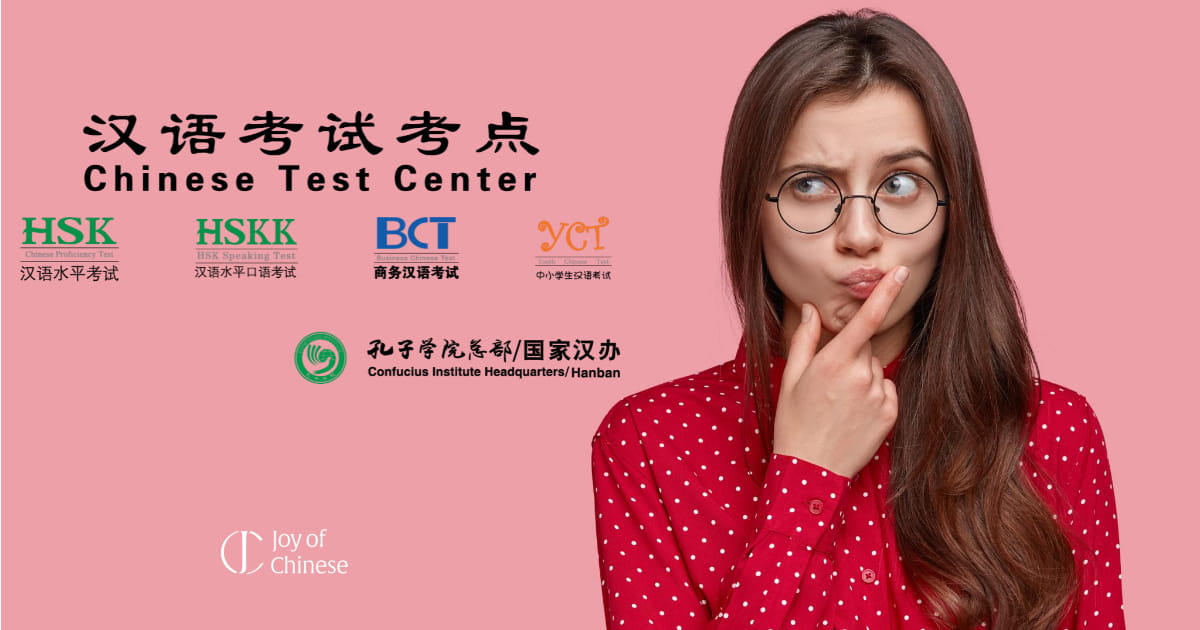
Four more specialized tests are also available: the HSK Speaking Test (HSKK), the Youth Chinese Test (YCT), the Business Chinese Test (BCT), and the Medical Chinese Test (MCT).
1. HSK Speaking Test (HSKK)
The HSKK (the HSK speaking test) assesses a candidate’s verbal competency.
There are three levels of HSKK: Primary, Intermediate, and Advanced. Each sublevel has three sections: listen and repeat, picture description, and answer the question.
They conduct the HSKK test using an audio recording. The HSKK assesses your pronunciation, tonal ability, fluency, and overall Mandarin proficiency.
The advanced level corresponds to level C of the Common European Framework of Reference for Languages (CEFR).
The maximum score is 100, and the minimum score required to pass the test is 60. Results are valid for two years following the announcement.
Because this is only an oral exam, you can combine it with other Chinese ability tests. They record the candidate’s speech during the interaction.
2. Youth Chinese Test (YCT)
Students whose mother tongue is not Chinese can take the new Youth Chinese Test.
Through YCT, test takers show their ability to express themselves in day-to-day activities. It is also for educational pursuits and professional experiences.
There are two independent tests — an oral exam and a written test.
Written language has four levels (I, II, III, and IV), while speaking has two levels (elementary and intermediate).
Within three weeks of passing the test, you will receive the results.
3. Business Chinese Test (BCT)
Peking University designed BCT in accordance with the guidelines of the Chinese Language Council International.
BCT assesses candidates’ Mandarin proficiency in business communication, professional settings, and everyday work.
Business Chinese Test has two independent tests — (listening & reading) and (speaking & writing). It is possible to take either or both tests at the same time.
The specific skill scores (listening, speaking, reading, and writing) range from 0 to 500; each level is 100.
Recently, they introduced two forms of tests: paper-based and computer-based.
There are two levels of written exams: BCT (A) and BCT (B). The score is valid for two years and has no minimum or maximum age requirements.
4. Medical Chinese Test (MCT)
Are you interested in pursuing an MBBS in China?
Take the Medical Chinese Test. They will conduct the 2026 exams in May and November.
The MCT program is for international students seeking to study medicine or non-medical fields in China, including clinical diagnosis.
They assess the candidate’s ability to communicate effectively in Mandarin in their field, including with patients, doctors, nurses, other medical personnel, and hospital staff.
MCT has three parts: reading, listening, and writing. Your score indicates your ability to communicate in the language.
You must also learn hundreds of words, phrases, and sentences related to medicine and pharmaceuticals.
All about Standard HSK
Here is everything related to the standard HSK (Hanyu Shuiping Kaoshi).
What are the HSK levels?
The HSK test comprises six levels: I, II, III, IV, V, and VI.
- HSK 1 — Knowledge of beginner Chinese words and phrases.
- HSK 2 — Ability to use basic Chinese and carry out simple tasks.
- HSK 3 – Can communicate daily for personal, academic, and professional goals.
- HSK 4 — Speak upper intermediate with native speakers on various topics.
- HSK 5 — You can speak fluently and read a Chinese newspaper.
- HSK 6 — Express yourself the way you want in any situation, either speaking or writing. Almost near-native.
- HSK 7-9 — Express in advanced settings, produce content on tough topics, and talk effectively in professional and academic settings.
HSK 1 and 2 cover writing and reading, while HSK 4, 5, and 6 include writing, reading, and listening.
The speaking section doesn’t exist. Thus, to test your speaking skills, take HSKK. The oral tests have three levels.
- (i) HSK (Elementary),
- (ii) HSK (Intermediate), and
- (iii) HSK (Advanced).
The new HSK levels (HSK 3.0)
HSK is undergoing the most significant reform in its history. A nine-level structure replaces the current six-level system, forming the “Three Stages and Nine Levels” test grading system.
They added levels 6-9 to align it with the CEFR scale. HSK levels 6 to 9 would be close to advanced C1 and near-native C2. The new format will be similar to the one below.
- HSK 1, 2, and 3 — Beginners, like A1 and A2.
- HSK 4, 5, and 6 — Intermediate, like B1 and B2, and
- HSK 7, 8, and 9 — Advanced, like C1 and C2.
There are 3 beginner levels: beginner, elementary, and pre-intermediate. HSK 3 will be identical to A2. Likewise, HSK 6 and 9 will look similar to B2 and C2.
The difficulty level, cumulative vocabulary, passing marks, and arrangement will also change.
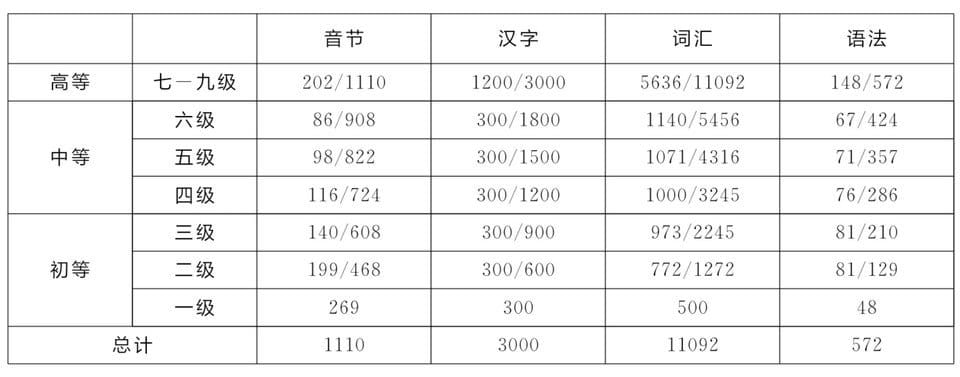
There would be one notable difference in the number of words. For example, the highest level will cover more than 10,000 vocabulary words rather than 5,000. This is necessary to bring it to level C2, near-native of CERF.
The new HSK 3.0 is more complex than the current HSK 2.0. For example, learners must study vocabulary, grammar, and characters in greater depth.
New HSK levels 7, 8, and 9, along with exams, were introduced last year.
Test structure and syllabus
Most questions are multiple-choice (MCQs) or True/false. However, there are also subjective questions at the higher levels.
Let’s find out the exact outline of each level, how many words it requires, and the test duration.
| HSK Levels | Description | Test Duration |
|---|---|---|
| HSK 1 | HSK Level 6 is the highest in the upper-intermediate range. You can use around 1,800 Chinese characters and roughly 5,456 words. You can produce complex written and spoken materials and handle professional and academic tasks. You can express yourself effectively in diverse contexts. | 40 |
| HSK 2 | HSK 2 is an elementary-level Chinese test that goes beyond beginners. You can recognize and use about 600 Chinese characters. You can comprehend around 1,272 words. You can discuss basic topics such as personal and family life, places, shopping, and work. You know more vocabulary and grammar than at Level 1. | 55 |
| HSK 3 | HSK 3 is the lowest level of the intermediate classification. You can identify and use about 900 Chinese characters and around 2,245 words. You can join discussions on everyday topics, share your personal experiences, and express your opinions. You can read simple materials such as menus, signs, and basic instructions. | 85 |
| HSK 4 | This stage is for intermediate learners and assesses more advanced language skills, including reading comprehension, writing, and handling complex conversations. You can use around 1,200 Chinese characters and about 3,245 words. Understand and produce written and spoken materials on various topics, such as work, studies, and daily life. You can engage in dialogues and handle more difficult language tasks. | 100 |
| HSK 5 | HSK 5 is a mid-level intermediate category and serves as is midpoint toward Mandarin ability. You can use around 1,500 Chinese characters and 4,316 words. You can articulate thoughts fluently on a range of topics, including social and cultural topics. You can also comprehend longer texts, such as articles, news, and literary works. | 120 |
| HSK 6 | HSK Level 6 is the highest level in the upper-intermediate range. You can use around 1,800 Chinese characters and around 5,456 words. You can make complex written and spoken materials and handle professional and academic studies. You can articulate effectively in diverse contexts. | 135 |
| HSK 7-9 | HSK 7–9 is for advanced learners seeking to master advanced skills, produce content on complex topics, and communicate effectively in professional and academic environments. You can understand around 3,000 Chinese characters and 11,092 words. You can express abstract ideas and use Chinese at a near-native level. You can speak fluently in all circumstances, including academic environments. You can view movies to learn Chinese and TV series for Mandarin learners, and listen to music with minimal difficulty. | 177 |
How does the HSK test work?
You can take the exam either online or in written form.
Here are some valuable pointers on the test before choosing a computer-based exam over a written exam.
- HSK 1 and HSK 2 are the primary HSK exams, including Pinyin and characters. Both tests require listening and reading.
- HSK 3 to HSK 6 have only Chinese characters without Pinyin. It has three sections: listening, reading, and writing.
I suggest the computer test. Most learners and foreigners may find writing every character by hand challenging.
You can easily score in the HSK test by typing the Pinyin on the keyboard and automating the characters.
The scoring system & passing mark
The maximum mark is 100 for each of the three sections: writing, reading, and listening.
They provide all the characters and Pinyin for the first two levels. In contrast, they do not offer Pinyin for the remaining levels; all content is in Chinese characters.
HSK 1 and 2 do not have a listening section, so the total score is 200. Thus, to pass, you must score at least 120 points out of 200.
HSK 4, 5, and 6 each have a maximum of 300 points. To pass, you must score 180 points out of 300.
What is the HSK score validity?
HSK test scores expire two years after the test date. Once the validity period ends, you must retake the test to be officially counted.
Suppose your goal is to enroll in a university in mainland China. In that situation, your scores are valid for only two years from the test date.
How to register for HSK?
Each exam has a different final date, so check the deadline before submitting your application.
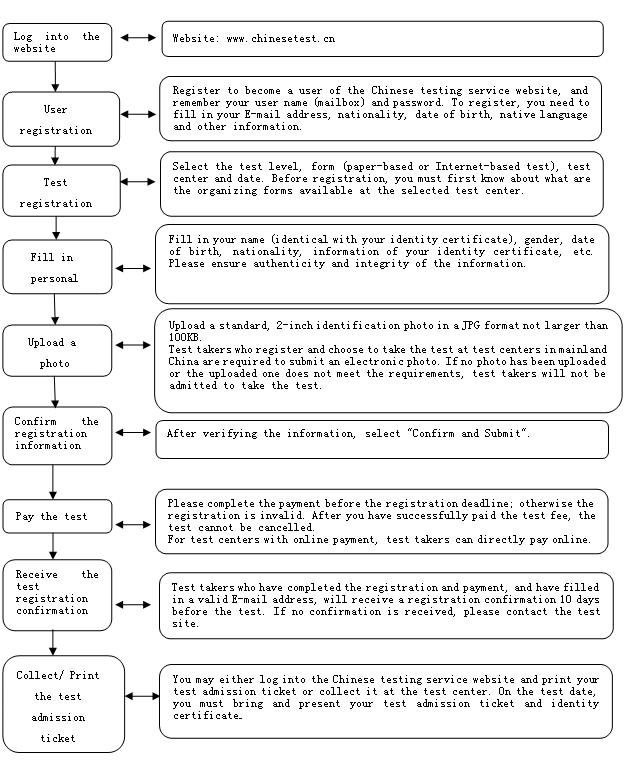
The official website lets you register directly to create a new account if you don’t already have one.
Afterward, you can select the level, dates, and test center, and choose between paper-based and online testing.
Next, upload your photo and enter your identification number (e.g., passport, driver’s license). Finally, submit the application form and payment.
You can also contact the nearest HSK test center for assistance with registration.
HSK testing centers
Chinese Testing International (CTI) is a government-funded organization that manages the Chinese test. They do this either independently or in collaboration with educational institutions worldwide.
As of January 2026, CTI maintains nearly 1400 HSK testing centers in around 220 nations and supports over 30 million Chinese students worldwide. Some exams can be taken online, but test centers may not offer every exam on every date.
Taiwan (the Republic of China) does not administer the test. Instead, Taiwan has its own Chinese exam, the TOCFL, which is not available in mainland China, Hong Kong, or Macau.
HSK 2026 test dates
They publish the test dates annually and typically administer them multiple times each month worldwide, so you have plenty of dates to choose from.
| 2026 Test Dates (Level 1 to 6) | Last date of registration for Paper-based Test (PBT) | Last date of registration for Internet-based Test (iBT) | Date of results (Paper/Internet) |
|---|---|---|---|
| Jan 24 (Sat) | Dec 28, 2025 | Jan 14 | Mar 3 / Feb 9 |
| Mar 22 (Sun) | Feb 23 | Mar 12 | Apr 22 / Apr 7 |
| Apr 11 (Sat) | Mar 15 | Apr 1 | May 15 / Apr 27 |
| May 16 (Sat) | Apr 19 | May 6 | June 16 / June 1 |
| June 28 (Sun) | June 1 | June 18 | July 28 / July 13 |
| July 18 (Sat) | June 21 | July 8 | Aug 19 / Aug 3 |
| Aug 23 (Sun) | July 27 | Aug 13 | Sept 23 / Sept 7 |
| Sept 13 (Sun) | Aug 17 | Sept 3 | Oct 19 / Sept 29 |
| Oct 17 (Sat) | Sept 20 | Oct 7 | Nov 17 / Nov 2 |
| Nov 7 (Sat) | Oct 11 | Oct 28 | Dec 7 / Nov 23 |
| Dec 13 (Sun) | Nov 16 | Dec 3 | Jan 15, 2027 / Dec 28 |
| 2026 HSK Test Dates (Levels 7-9) | Last date of registration for Internet-based Test (iBT) | Date of results (Internet) |
|---|---|---|
| May 9 (Sat) | Apr 25 | June 9 |
| Nov 22 (Sun) | Nov 5 | Dec 22 |
The registration period often lasts four weeks before the exam. However, for internet-based exams, the deadline is ten days before the respective test.
HSKK 2026 speaking exam dates
| 2026 Test Dates | Last date of registration for Paper-based Test (PBT) | Last date of registration for Internet-based Test (iBT) | Date of results (Paper/Internet) |
|---|---|---|---|
| Jan 24 (Sat) | Dec 28, 2025 | Jan 14 | Mar 3 / Feb 13 |
| Mar 22 (Sun) | Feb 23 | Mar 12 | Apr 22 / Apr 13 |
| Apr 11 (Sat) | Mar 15 | Apr 1 | May 15 / May 8 |
| May 16 (Sat) | Apr 19 | May 6 | June 16 / June 5 |
| June 28 (Sun) | June 1 | June 18 | July 28 / July 20 |
| July 18 (Sat) | June 21 | July 8 | Aug 19 / Aug 7 |
| Aug 23 (Sun) | July 27 | Aug 13 | Sept 23 / Sept 14 |
| Sept 13 (Sun) | Aug 17 | Sept 3 | Oct 19 / Oct 9 |
| Oct 17 (Sat) | Sept 20 | Oct 7 | Nov 17 / Nov 6 |
| Nov 7 (Sat) | Oct 11 | Oct 28 | Dec 7 / Nov 27 |
| Dec 13 (Sun) | Nov 16 | Dec 3 | Jan 15, 2027 / Jan 4, 2027 |
2026 examination fee
The test fee varies depending on where you take the test.
Its cost is comparable to other popular language tests, such as DELE, CILS, DELF, SIELE, CIPLE, and Goethe-Zertifikat. But higher than exams such as the JLPT and TOPIK.
For instance, prices in the USA range from $30 to $80. In India, it is between ₹ 1500 and ₹ 6500.
In mainland China, HSK Level 1 costs 150 RMB. After that, the price increases by 100 RMB for each grade. The highest level, level 6, is 650RMB.
How to prepare for HSK?
Chinese is one of the most challenging languages. But there are ways to simplify it.
Success in the HSK test requires passion, perseverance, practice, and preparation.
With widespread internet access, many online learning resources are available, including books, Chinese learning apps, audio and video lessons, and LMS platforms.
These can be a starting point, but not an end. Most online study materials are geared towards beginners rather than higher levels (3 to 6).
Finding an experienced teacher or enrolling at a Chinese institute will prove more beneficial. The great news is that major cities have no shortage of language centers.
The fastest way to pass the HSK is to enroll in a Mandarin Chinese course at a language school. Keats offers an intensive HSK Test Preparation Course for those planning to learn Chinese in China.
As language and culture intertwine, you can also learn about China’s history and cultural aspects.
To help you prepare better and ace the exam, you can also find the sample papers and previous year’s questions on the websites.
Should you take the Chinese HSK Test?
You might want to know how much you studied and your exact level. It is reasonable to expect a minimum score for a visa application in China.
An HSK certificate can help you demonstrate your proficiency in Mandarin to potential employers. Plus, you might want to improve your Chinese proficiency for career advancement.
The HSK test is an excellent way to differentiate yourself from competitors, regardless of your motives.
The HSK test certificate can add significant value to your resume. Plus, it can help you achieve considerable success in your personal, academic, and professional goals!
Do you intend to take the exam? Share your views and questions in the comments below.







How can Indians register for the HSK examination? Can we get some links?
You have to contact the nearest test centers, and they will provide you options on how to register yourself. For example, Mumbai University conducts the test. You can check the list of testing centers on the official website.
Please i want to learn how to speak Chinese